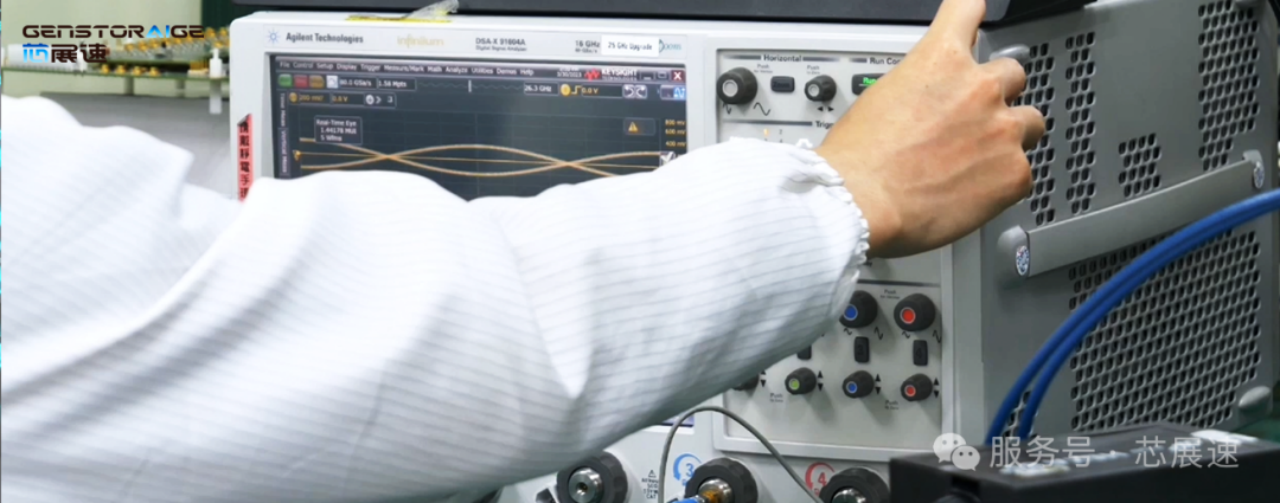
In the past two weeks, we discussed two topics: "Why Retimers Are Needed" and "The Difference Between Retimers and Redrivers." This week, let's look directly at a product—GenstorAIge's GE5216, a 16-channel Retimer designed for PCIe 5.0 and CXL 2.0.
The GE5216 excels in equalization, latency, flexibility, and ease of use. Let's break down each aspect.
42dB Ultra-Wide Equalization Range, 6dB Higher Than the PCI-SIG Standard
The core task of a Retimer is equalization, compensating for the attenuation of high-frequency signal components during transmission. Stronger equalization capability supports longer PCB traces and relaxes requirements for connectors and cables.
The PCI-SIG specification requires 36dB of equalization for a PCIe 5.0 Retimer. The GE5216 achieves 42dB, exceeding the standard by 6dB. Note: This 42dB equalization range requires pairing with GenstorAIge-brand SSDs.
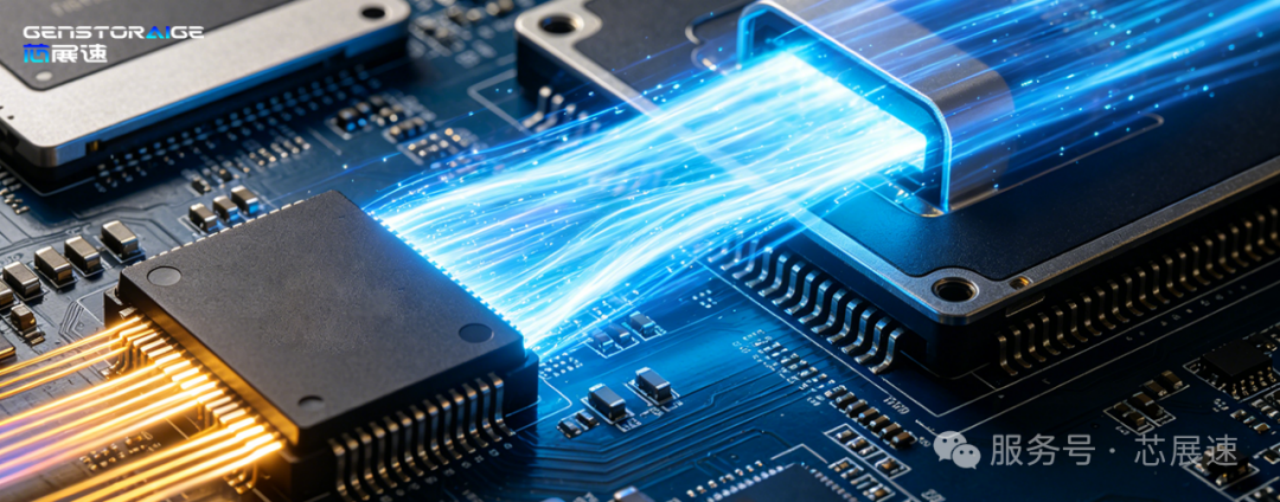
The extra 6dB offers tangible engineering benefits:
• Longer Traces:On typical server backplane materials (like Megatron 6), 6dB can support approximately 8-10 inches of additional trace length.
• Greater Margin:When using lower-quality cables or connectors, the link remains stable, significantly reducing consistency pressure on the production line.
• More Complex Topologies:It supports scenarios with 2-3 internal connectors plus a 1-meter passive cable, easily handling the complex interconnects inside AI servers.
The GE5216's 42dB performance is in the top tier among mass-produced PCIe 5.0 Retimers.
<5ns Latency, No Bottleneck
A Retimer contains a CDR circuit and must receive complete data, resample it, and then transmit it, so latency is unavoidable. However, excessive latency impacts end-to-end access speed, a critical concern for latency-sensitive applications like storage and CXL.
The GE5216's end-to-end latency is less than 5ns. For reference: a Redriver is generally <100ps (0.1ns), while typical Retimers range from 2-10ns. The GE5216's <5ns latency is on par with top international manufacturers.
The cost of a signal passing through the GE5216 is five-billionths of a second. As overall PCIe link access latency is typically in the hundreds of nanoseconds to microseconds, this increment is virtually imperceptible. Trading a tiny performance loss for link stability is a worthwhile deal.
Flexible Link Bifurcation, Supports Hot-Swap
PCIe topologies in AI servers and storage systems are becoming increasingly complex, moving beyond simple CPU-to-device direct connections.
The GE5216 supports multiple bifurcation modes: x16, x8, x4, and x2:
• 1x16: A single 16-channel link for an x16 GPU or expansion card.
• 2x8: Bifurcated into two independent 8-channel links.
• 4x4: Bifurcated into four 4-channel links for NVMe SSDs.
• 8x2: Bifurcated into eight 2-channel links for low-speed peripherals.
Each link can independently handle hot-swap, allowing devices to be plugged or unplugged during operation without affecting other links. This feature is essential for servers and data center equipment requiring online maintenance.
Self-Developed Diagnostic Tool + BMC SDK
No More Guesswork in Debugging
Many engineers feel that while Retimers do solve signal problems, tuning them is like opening a mystery box. You don't know if the equalization parameters are correct or how much link margin remains, forcing you to rely on experience and trial-and-error when issues arise.
GenstorAIge equips the GE5216 with a diagnostic tool and BMC SDK, transforming debugging from "guessing" to "seeing."
What the diagnostic tool can do:
• Lane Margining: Measures the signal margin of each lane to check if equalization settings are optimal.
• Eye Diagram Capture: Directly views the eye opening at the receiver, making link quality clear at a glance.
• Temperature Monitoring: Reads the chip's junction temperature in real-time, providing early warnings for overheating.
• Error Logging: Records the type and time of link errors for easy fault location.
The BMC SDK provides standard C language APIs, allowing you to develop custom firmware management features such as remote upgrades, link status monitoring, and diagnostic information reporting.
The GE5216 is more than just a bare die; it comes complete with the chip, tools, and SDK. Link status is quantifiable and visualizable, eliminating guesswork from debugging.
Conclusion
The GE5216's key specifications—42dB equalization (requires pairing with GenstorAIge-brand SSDs), <5ns latency, flexible link bifurcation and hot-swap, plus visual diagnostic tools and a BMC SDK—combine to make it a competitive offering among domestic high-end Retimers.
Next week, we'll share real-world test data—how the 42dB performance holds up in an actual backplane environment. Stay tuned. For the "GE5216 Datasheet" or to "Apply for Sample Testing," please feel free to contact us.
Website: www.gsaitech.com